
Karryn’s Prison Screenshots

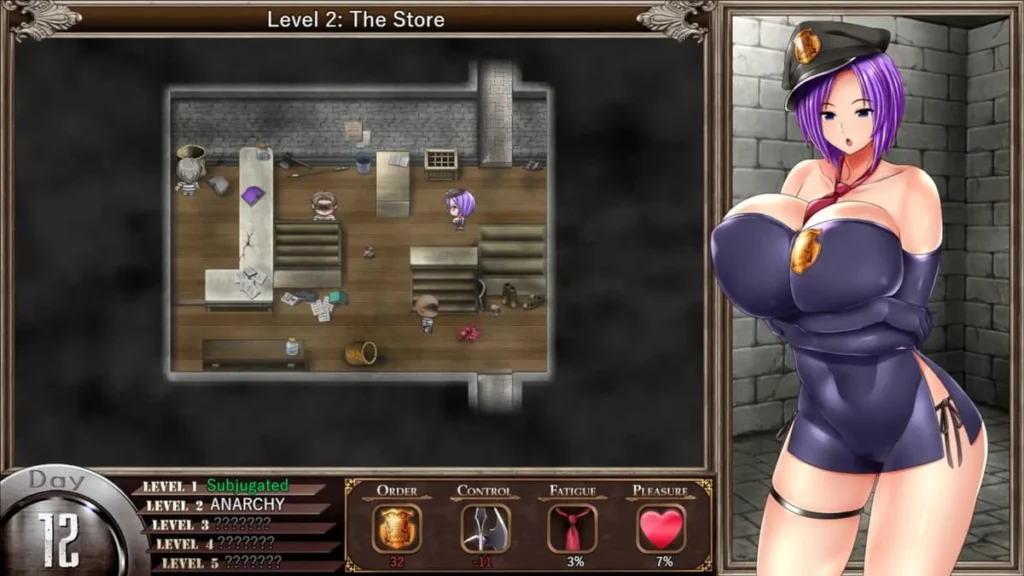
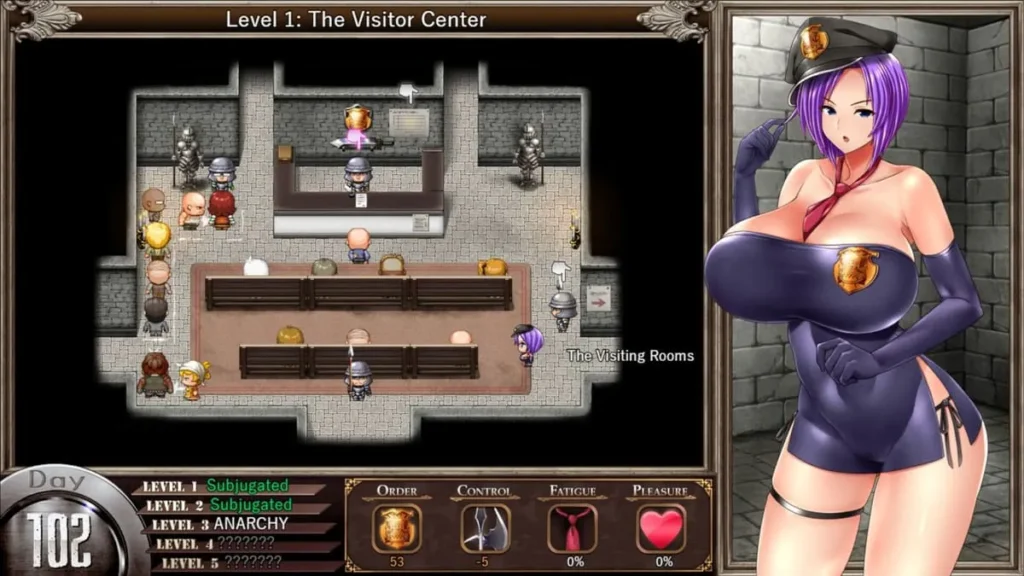







Karryn’s Prison review
Explore the innovative blend of strategy, management, and narrative in this unique indie title
Karryn’s Prison stands out as a uniquely designed indie game that merges multiple gameplay systems into a cohesive experience. Players assume the role of Karryn, a newly appointed Chief Warden tasked with managing a notorious all-male correctional facility while navigating complex decision-making scenarios. The game distinguishes itself through its integration of turn-based tactical combat, prison management simulation, and character relationship systems. What makes Karryn’s Prison particularly noteworthy is how its narrative progression directly intertwines with player choices and gameplay outcomes. This comprehensive guide explores the core mechanics, gameplay systems, and design philosophy that have earned the game recognition within the indie gaming community.
Core Gameplay Systems & Mechanics
So, you’ve heard about this game where you run a prison, but it’s also a turn-based JRPG, and there’s a whole narrative about relationships? 🤔 It sounds like a wild mashup, and that’s because it is. Understanding how does Karryn’s Prison gameplay work is the key to unlocking its unique charm. It’s not just one thing; it’s a brilliant, sometimes chaotic, fusion of three deep systems that constantly talk to each other. You’re not just a warden or a fighter—you’re a strategist juggling daily operations, tactical skirmishes, and delicate interpersonal dynamics, all of which shape your story.
At its heart, the Karryn’s Prison gameplay mechanics are built on three interconnected pillars: JRPG tactical battles, a deep prison management simulation, and a consequential character relationship system. Mastering one area can help you in another, while neglecting one can lead to a cascade of problems. It’s this dance between duty, combat, and conversation that makes every playthrough feel personal and packed with meaningful choices.
To see how these systems support each other, here’s a quick breakdown:
| Gameplay System | Primary Player Function | Key Objectives | Impact on Overall Progression |
|---|---|---|---|
| Turn-Based Combat | Tactical Commander | Win battles, subdue inmates, gather resources, build reputation. | Directly affects character relationships, unlocks story scenes, and provides crucial materials for prison upgrades. |
| Prison Management | Administrative Warden | Allocate staff, manage facilities, maintain order, generate income. | Determines available resources for combat and upgrades, influences inmate behavior, and unlocks new gameplay areas. |
| Character Relationships | Social Strategist | Build trust or dominance with key characters through choices in and out of combat. | Branches the narrative, unlocks special abilities or scenes, and alters ending conditions based on accumulated points. |
Now, let’s lock into the details of each system and see what makes this blend of indie game mechanics so special. 🎮
Turn-Based Combat & Strategic Battles
Forget what you know about random encounters or grinding in a vacuum. The turn-based combat system in Karryn’s Prison is a polished, strategic layer that’s deeply woven into the fabric of everything else. When an “incident” occurs in your prison—and it will—you’ll enter a classic JRPG-style battlefield. But here, every action carries weight far beyond dealing damage.
The battles themselves are delightfully tactical. You command Karryn, positioning her on a grid, managing Action Points (AP), and choosing from a variety of skills. Will you go for a powerful, AP-heavy attack to try and end things quickly, or use cheaper skills and guard to wear down a tougher opponent? 🤺 The enemy AI isn’t passive; inmates will use skills that can debuff you, lower your guard, or try to turn the social tables. It’s in these JRPG tactical battles that you feel the core loop of risk and reward. Winning a fight cleanly improves discipline and earns you valuable Contraband items used for crafting and upgrades. But the combat isn’t just about winning—it’s how you win.
Pro Tip: Don’t just spam your strongest attack! Using the “Talk” command or specific non-lethal skills during battle is often the key to influencing the character relationship system. Sometimes, a strategic conversation can be more valuable than a knockout blow.
This is where the magic of integration happens. The choices you make during combat directly feed into the relationship meters for the characters you’re facing. Being merciful or forceful, using certain dialogue options, or even the skills you employ will shift their perception of you. I remember one playthrough where I kept trying to brute-force my way through every encounter with a particular inmate. I won every fight, but our relationship tanked, locking me out of a whole narrative branch that offered a much easier management path later on. It was a classic lesson: short-term victory can lead to long-term complications. This direct link between battle actions and narrative consequences is a standout feature of the Karryn’s Prison gameplay mechanics.
Prison Management & Resource Allocation
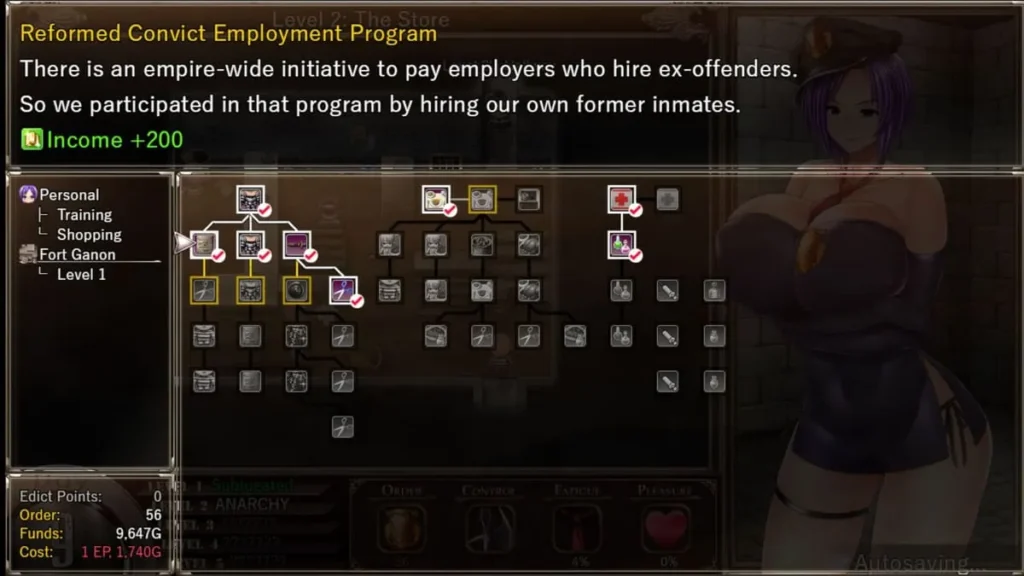
When you’re not in the thick of a tactical scrap, you’re in the warden’s chair, and this prison management simulation is anything but a simple side activity. It’s the engine room of your entire operation. Your screen becomes a dashboard of needs: inmate morale, facility cleanliness, staff fatigue, and that all-important budget. 💰
You’ll be hiring and assigning guards to patrol routes, ordering cleaners to maintain hygiene (which affects morale and health), and investing in facility upgrades like better beds or training equipment. Every decision costs money and resources, which are earned through inmate labor, successful combat outcomes, and… other means. The management loop is incredibly engaging because it’s always tense. If you neglect hygiene, sickness can spread, reducing labor output. If you work inmates too hard without improving amenities, riots become more likely, throwing you into more JRPG tactical battles.
The prison management simulation also introduces a brilliant risk/reward layer with inmate “jobs.” You can assign inmates to work in the kitchen, the mine, or the workshop. These jobs generate essential resources—food, ore, crafted parts—but they also expose those inmates to new “ideas” and opportunities to obtain Contraband. It’s a constant balancing act. Do you put your most troublesome inmate in the mine for hard labor, knowing it might make them stronger and more rebellious? Or do you give them a softer job to pacify them, at the cost of lower resource yield? This kind of meaningful choice is the hallmark of great indie game mechanics.
Your management prowess directly enables your combat effectiveness. Upgrades purchased with managed resources can give Karryn new abilities or passive bonuses. A well-run prison means fewer chaotic incidents, allowing you to pick your battles more strategically. Conversely, if your management is a mess, you’ll be constantly firefighting, draining your energy and resources in a vicious cycle. It’s a profoundly satisfying system that makes you feel like a true administrator, where every gold coin and piece of lumber has a purpose.
Character Progression & Relationship Dynamics
If combat is the action and management is the logistics, then the character relationship system is the soul of your story. This isn’t a simple “like/dislike” meter. It’s a complex web of shifting dynamics that changes based on almost everything you do. Every major character has multiple relationship metrics that track your interactions, and these points are accrued in the most organic ways: through dialogue choices in events, through your actions in the turn-based combat system, and through your decisions in the prison management simulation.
Let’s break it down with a concrete example. Imagine you have a repeat offender, a cunning inmate who often starts trouble.
-
Combat Choice: You encounter her in a battle. You could:
- (A) Defeat her quickly with force, earning Respect points but lowering her Trust.
- (B) Use the “Talk” option and choose a persuasive dialogue, earning Trust points but potentially losing Respect.
- (C) Use a specific non-lethal skill to subdue her, which might earn a unique type of point.
-
Management Choice: Later, you assign her to a job.
- (A) Put her in solitary confinement (lowers Trust, might increase Fear).
- (B) Assign her to a favored job in the library (increases Trust).
- (C) Force her into hard labor in the mines (increases Respect/Fear, lowers Trust).
-
Narrative Consequence: The sum of these choices determines which “route” you are on with this character. High Trust might unlock a subplot where she becomes a reluctant informant, making your management easier. High Respect/Fear might lead to a storyline where she challenges your authority directly in a major showdown. These routes have different endings, different scenes, and grant different permanent bonuses or items.
This system answers the core question of how does Karryn’s Prison gameplay work on a narrative level: through layered, consequential choice. Your character progression isn’t just about leveling up stats; it’s about progressing through a web of relationships that you’ve personally shaped. It makes a roughly 12-hour playthrough on easier settings feel incredibly dense with possibility, as you realize that a seemingly minor choice in Week 1 can butterfly-effect into a major story branch in Week 3.
The genius of Karryn’s Prison is that no system exists in isolation. A battle changes a relationship. A relationship affects how an inmate behaves in your prison. That behavior changes your management needs. Your management resources determine how prepared you are for the next battle. 🎯 It’s a brilliant, self-reinforcing loop of Karryn’s Prison gameplay mechanics that respects your intelligence as a player. You’re not just following a story or optimizing a spreadsheet; you’re living the chaotic, challenging, and deeply strategic life of a warden in a world where every decision, from the battlefield to the budget report, writes your own unique tale.
Karryn’s Prison demonstrates how indie developers can create compelling experiences by thoughtfully integrating multiple gameplay systems into a unified whole. The game’s strength lies not in any single mechanic, but in how its turn-based combat, management simulation, and relationship systems work together to create meaningful player agency. The polished integration of these elements, combined with the approximately 12-hour campaign length, offers players a substantial and engaging experience. The game’s design philosophy prioritizes player choice and consequence, ensuring that decisions made during both combat and management phases carry weight throughout the narrative. For players interested in indie games that blend strategic gameplay with narrative depth, Karryn’s Prison represents a notable achievement in game design that rewards experimentation and thoughtful decision-making.